
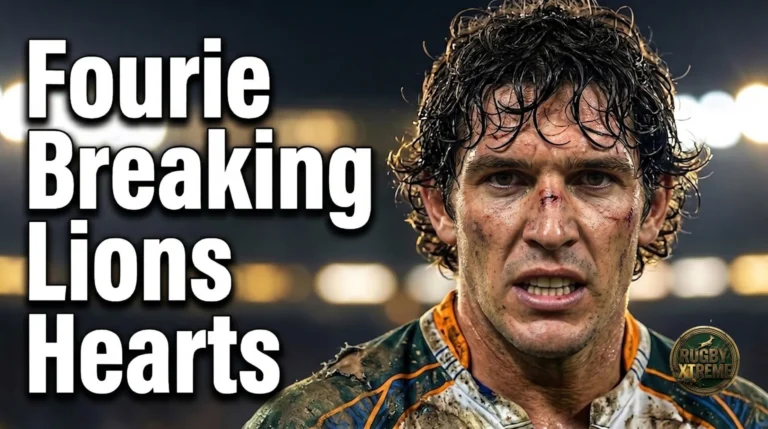
The 2009 British and Irish Lions tour to South Africa is a ghost story told in locker rooms. It was brutal. It was draining. It was the kind of series that left permanent scars. The Lions arrived with a squad heavy with Northern Hemisphere royalty, and their singular goal was to tear apart the reigning World Champions right in their own backyard. Then came the second test at Loftus Versfeld. The altitude burns your lungs. The crowd screams until your ears ring. The Springboks hit with a sickening thud. This was not a standard rugby match. It was a street fight disguised as a test, where every single collision felt fiercely personal. Out of this absolute chaos, Jacque Fourie carved his name into the bedrock of Springbok history.
You have to look at the scoreboard and the clock to truly feel the crushing weight of this try. 74 minutes down. The Springboks are trailing. The entire series is slipping through their fingers. If the Lions win, we go to Johannesburg for a decider with the momentum completely flipped. The tension inside Loftus Versfeld was thick enough to choke on as South Africa launched wave after desperate wave of attack. They hammered against a red wall that simply refused to crack. Shaun Edwards had drilled his Lions defense to perfection, absorbing massive hits and scrambling for their lives. But elite rugby is a cruel game. It turns on microscopic errors. It flips on a single moment of individual magic that tears up the defensive playbook entirely.
Look closely at the buildup because it is an absolute masterclass in exploiting a blindside when lungs are burning and legs are dead. Morne Steyn is usually known for his pragmatic boot and his calm head. Here, he spots a fatal crack in the Lions defensive realignment. The ball comes out of a messy central ruck, and Steyn sees the narrow spacing on the right flank instantly. He throws a flat, sweeping pass that cuts out the midfield crash completely. The Lions edge defenders are suddenly isolated. That one split second decision warps the geometry of the entire pitch. The red shirts are forced to turn and scramble, their aggressive line speed vanishing into thin air.
Jacque Fourie did not get the ball in open space. The cover defense was already there and hunting him down. What happens next makes absolutely no biomechanical sense. A normal winger chips the ball. A normal winger tries to step inside and recycle the phase. Fourie opted for pure, unadulterated violence. He pinned his ears back and ran straight into the collision. The impact should have thrown him violently into the touchline camera crews. Instead, he contorted his massive frame in mid air. He absorbed the hit, kept his momentum pushing forward, and reached out for the tryline while his legs hovered miraculously above the touchline chalk. You need the power of a blindside flanker and the body control of a gymnast to pull that off.
The stadium erupted and then instantly fell dead silent. The referee pointed to the Television Match Official, and those massive screens at Loftus Versfeld played back the most stressful replay in rugby history. Frame by agonizing frame, millions of people stared at a boot, a blade of grass, and a thick white line of chalk. Lions fans will swear until their dying breath that the stud brushed the line. Springbok fans will show you the microscopic gap in high definition. When the word Try finally flashed on the screen, the roar physically shook the stadium concrete. That single call altered the destiny of the series and started a decade of bitter arguments over technology in sports.
Five points on a scoreboard does not tell the whole story. This try was a psychological execution. The Lions had tackled their hearts out for 73 minutes. They pushed their bodies beyond human limits, only to watch their resistance crumble against sheer willpower. Look at their body language right after the conversion. Shoulders slumped. Eyes staring at nothing. Hands resting heavy on knees. They were completely broken. That try shattered their belief. Morne Steyn hitting the final penalty from his own half was just the ceremonial finish, but Fourie driving through the corner was the actual fatal blow.
South African rugby is built on legendary moments. Joel Stransky kicking the drop goal in 1995. Makazole Mapimpi flying down the wing in Japan. Cheslin Kolbe stepping into immortality. The 2009 Jacque Fourie corner finish belongs in that exact same breath. It is everything that makes Springbok rugby terrifying. Uncompromising physicality. Relentless pressure. An absolute refusal to ever back down. Fourie proved he was not just a world class center filling in out wide. He showed he was a cold blooded killer who could execute perfection when the pressure was utterly unbearable.
This single moment changed how defensive coaches sleep at night. Before 2009, corner flagging was a desperate scramble where you just threw your body at the guy and hoped for the best. After Fourie demolished that theory, elite teams started rethinking the wide channels. They started teaching players to target the hips. The goal became wrestling the man out of bounds instead of trying to win a high impact collision near the flag. The sheer absurdity of Fourie scoring from that position proved that traditional tackling is utterly useless when a freak athlete hits the corner with bad intentions.
The internet runs on moments that make you argue, gasp, and hit replay. This try is the ultimate digital asset because it hits every emotional trigger at once. National pride. Tactical genius. Referee controversy. Freak athletic ability. You watch it the first time to see the score. You watch it the second time to appreciate the pass. You watch it twenty more times trying to see if that boot actually touched the white chalk. It is a timeless masterpiece of athletic violence that will keep filling up social feeds and starting fights in comment sections for as long as the game is played.
Wait, did his boot actually touch the line? If you ask a Lions fan, absolutely. If you ask a Springbok, it was daylight all the way. The official TMO call stands, but the pub debate is immortal.
Why did the defense not just push him out into touch? They definitely tried. Fourie was just too big and moving too fast. He had a center of gravity that defied the laws of physics at the exact point of impact.
Is this truly the greatest Springbok try ever? It is undeniably the most debated. When you combine the context of a Lions series, the ticking clock, the looming defeat, and the sheer impossibility of the grounding, it easily sits right at the top.
If you enjoyed this breakdown, don't keep it to yourself. Share it with your fellow analysts, friends, or anyone who lives for the pure grace of the game. Let's keep the legacy alive.
Want to get your brand in front of a dedicated, high-impact rugby audience? Rugby Xtreme is expanding, and we are open for business. Make contact with us today to discuss premium advertising opportunities and partner with our content!
👇 Support the Channel & Join the Community:
🔔 Subscribe here
© 2026 Rugby Xtreme. All rights reserved.
 Translate
Afrikaans
Translate
Afrikaans  Amharic
  Arabic
  Belarusian
  Bulgarian
  Bengali
English
Bengali
English  Sundanese
  Swedish
  Swahili