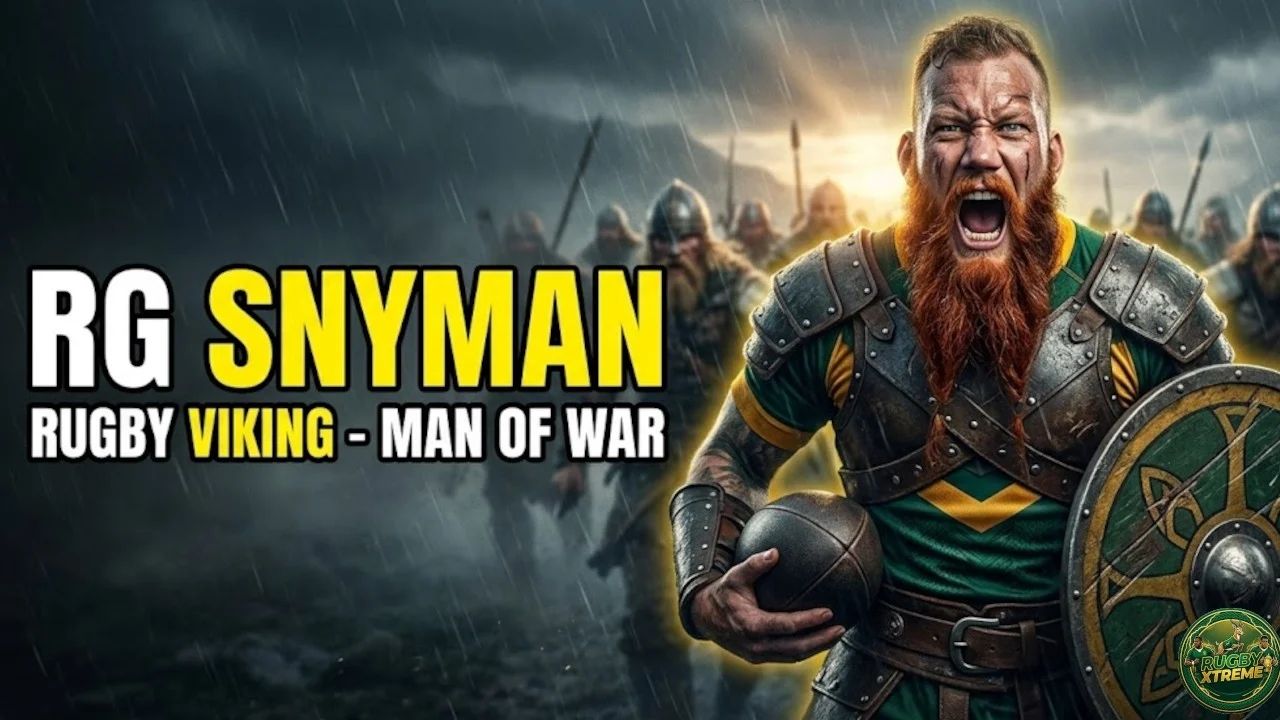

To understand Rassie Erasmus, one must first look past the chaotic theater of social media and the polarizing tactical innovations. You have to look at the shadows of the locker room, which is the space where the visceral grit of the player meets the cold, analytical machinery of the coach. Rassie is a man split down the middle: a former back-rower who played with a destructive, cerebral physicality, and a director of rugby who treats the game like a grand architectural project. He is not merely a leader; he is South Africa’s primary psychological cartographer, a man who mapped the soul of a nation and realized that its greatest weapon was its own perceived fragility.
As a player, Erasmus was a harbinger of the modern hybrid forward. He did not just participate in the breakdown; he audited it. In an era often defined by raw, unstructured aggression, Rassie brought a chilling level of technical intelligence to the number seven jersey. His lateral speed and ability to read the half-back’s intention allowed him to suppress opposition momentum before it could crystallize into a threat. He was a player of immense work rate, yet his impact was rarely about the volume of tackles. It was about the timing, the invisible work at the bottom of a ruck that secured a turnover or the subtle positioning that forced a fly-half into a hurried, poor decision. He played with a heightened sense of tactical anticipation, a trait that would later become the bedrock of his coaching philosophy.
The transition from the dirt of the pitch to the digital glow of the coaching tablet was not a change of identity, but an expansion of it. Erasmus the Coach is a direct evolution of Erasmus the Player. He realized early on that international rugby is a game of marginal gains hidden within massive emotional stakes. His implementation of the Bomb Squad, the 6:2 or 7:1 split on the bench, was not just a physical tactic to ensure scrummaging dominance; it was a psychological siege. It was a statement to the opposition that the pressure would never let up, and that the violence of the contest would be refreshed at the sixty-minute mark. This is where his background as an elite forward shines through. He understands the cumulative fatigue of the forward pack better than anyone, and he built a system that weaponizes fresh legs to crush the spirit of tired men.
His leadership presence is characterized by a radical, almost uncomfortable transparency. In a sport that often hides behind clichés, Rassie chose to pull back the curtain. By exposing the tactical why to his players and the public, he removed the mystery that often breeds doubt. He replaced uncertainty with a clear, uncompromising mission. This influence on his teammates and later his players created a culture of extreme accountability. He did not just ask for resilience under pressure; he engineered environments where pressure was the primary fuel. He turned the Springboks into a high-performance system: scalable, data-driven, and relentlessly focused on the outcome. This culture is predicated on high signal density, ensuring every communication either deepens the tactical understanding of the squad or sharpens their emotional edge before a match.
The resilience he exhibited during the 2019 and 2023 World Cup cycles was a masterclass in narrative control. Under the crushing weight of a nation’s expectation, he remained an intelligently observant outlier. He navigated the complexities of transformation and cultural relevance with a pragmatism that felt grounded in reality rather than political necessity. He saw the diversity of the squad not as a hurdle, but as a strategic advantage, which was a collision of different strengths that, when unified by a common goal, became unbreakable. His legacy will not just be the trophies in the cabinet, but the blueprint he left for how to manage human potential in its rawest form.
Ultimately, Rassie Erasmus matters because he dared to be the Maverick in a world of conformists. He prioritized high signal density over empty praise, and tactical rugby intelligence over traditional tropes. He remains the ghost in the machine of South African rugby, the man who outran the enemy by simply outthinking them. To watch the Springboks today is to see Rassie’s mind in motion, a seamless blend of brutalist physicality and sophisticated pacing. He is the myth, the legend, and the ultimate disruptor of the status quo. His career serves as a master blueprint for the sport, proving that emotional calibration and the injection of belief into a team’s psyche are as vital as physical training. He transformed the identity of South African rugby from a fractured entity into a singular, high-performance engine of dominance.
If you enjoyed this breakdown, don't keep it to yourself. Share it with your fellow analysts, friends, or anyone who lives for the pure grace of the game. Let's keep the legacy alive.
Want to get your brand in front of a dedicated, high-impact rugby audience? Rugby Xtreme is expanding, and we are open for business. Make contact with us today to discuss premium advertising opportunities and partner with our content!
👇 Support the Channel & Join the Community:
🔔 Subscribe here
© 2026 Rugby Xtreme. All rights reserved.
 Translate
Afrikaans
Translate
Afrikaans  Amharic
  Arabic
  Belarusian
  Bulgarian
  Bengali
English
Bengali
English  Sundanese
  Swedish
  Swahili